Why Trying to Time the Market During Crises Rarely Works
Over the past few weeks, I’ve had a number of conversations with clients that all start with a similar question.
“James, should we be doing anything with our investments right now?”
It’s a completely understandable question. When global events dominate the news and markets begin moving around more than usual, the natural instinct is to protect what you’ve worked hard to build.
The Idea Sounds Sensible
When markets feel uncertain, it’s very easy to think along these lines:
“Maybe I should move my investments to cash for a while and wait until things calm down.”
On the surface, that sounds perfectly reasonable, but in reality, this strategy requires something incredibly difficult to achieve.
You have to make two perfect decisions:
- When to sell
- When to buy back in
Getting either of those decisions wrong can have a significant impact on long-term returns and the reality is that even professional investors struggle to do this consistently.
Markets don’t move in neat, predictable patterns. They react quickly to new information, and recoveries often begin long before the news itself improves.
Markets Recover Before the Headlines Improve
One of the biggest challenges with market timing is that markets are forward-looking. Prices adjust based on expectations of the future, not simply what’s happening today. A good example of this was the COVID-19 market crash in 2020. In March of that year, global markets fell sharply as lockdowns spread across the world. The MSCI World Index dropped by roughly 30–35% in just a few weeks. At the time, the outlook felt incredibly uncertain. However, markets began recovering almost immediately afterwards and months before vaccines were available and long before the pandemic itself had ended. By the end of 2020, many global markets had already recovered their losses and moved higher. Investors who sold during the panic and waited for certainty often found that markets had already moved significantly higher by the time they felt comfortable reinvesting.
The Hidden Cost of Trying to Step Out
There’s another reason why trying to time the market can be so damaging to long-term returns.
Some of the strongest market days tend to occur very close to the worst days.
In fact, research looking at long-term market data shows something quite striking.
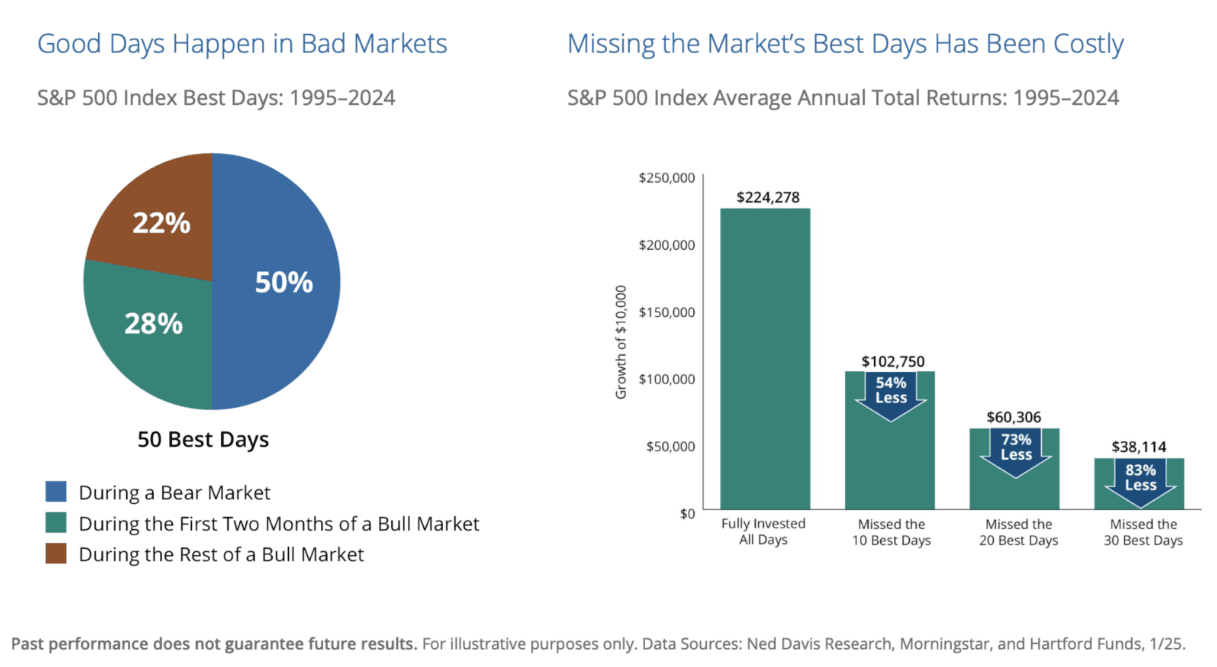
Seventy-eight percent of the stock market’s best days have occurred during a bear market (prices falling), or within the first two months of a new bull market (prices rising). In other words, the biggest upward moves often happen right when investors feel the most uncertain.
If an investor missed just the 10 best days in the market over the past 30 years, their overall investment returns would have been cut roughly in half. Miss the best 30 days, and their returns would have been reduced by an astonishing 83%.
Think about that for a moment, over a 30-year investing journey there are roughly 7,500 trading days. Yet missing just 30 of those days, less than half of one percent of the time can dramatically reduce long-term wealth and the difficult part is that those best days rarely arrive when everything feels calm and comfortable again. They tend to appear during periods of volatility, when investors are most tempted to step aside and wait for clarity.
Why Having a Plan Matters
This is where proper financial planning becomes incredibly valuable.
That typically means:
- Maintaining a diversified global portfolio and one which is in line with your goals.
- Being invested in the right asset classes that are aligned with your true risk profile and financial plan.
- Keeping costs under control.
When those foundations are in place, short-term market movements rarely require dramatic changes. The majority of the time the most productive investment decision during uncertain periods is to do absolutely nothing.
A Final Thought
Moments like the one we’re experiencing now naturally create uncertainty. Markets will react to global events, that’s part of how they function, but history consistently shows that trying to jump in and out of markets during periods of volatility is extremely difficult to do successfully.
For long-term investors, patience, discipline and perspective have historically been far more valuable and beneficial than trying to predict the next market move.
So sit tight and stick to the plan.
Ready to Take the Next Step?
If you’d like to discuss your financial plan or want reassurance during uncertain times, you’re welcome to book a confidential discovery meeting.
No pressure, no obligation — just a conversation about where you are today and whether your current strategy supports your long-term goals.
Enjoyed this article?
Get the next one delivered to your inbox.
Comments
Loading comments...
Related Articles
Continue reading more insights on financial planning.

Active vs. Passive: What This Year's Scorecard Really Says

Investment Risk: The Risk Of Low Returns And Falling Short Of Your Financial Goals