Market Update: Middle East Tensions and Market Volatility

The events unfolding in the Middle East over the past few days have understandably created concern across the world. First and foremost, my thoughts are with everyone affected by the situation and I sincerely hope that people remain safe during what is clearly a difficult and uncertain time.
From a market perspective, tensions have caused some short-term turbulence. Global shares and bonds have both experienced declines, while oil prices have jumped as investors react to the risk of potential disruptions to energy supplies.
When oil prices rise quickly, it can increase concerns about inflation and influence expectations around interest rates. That combination often makes investors more cautious in the short term, which is why markets can become more volatile during periods like this. However, it’s important to keep recent market movements in perspective.
At the moment, markets are not signalling expectations of a prolonged disruption to global economic growth. What we are seeing is largely a short-term reaction to uncertainty rather than a fundamental shift in the long-term outlook.
Periods where both shares and bonds fall at the same time usually happen when investors are uncertain about inflation and the future path of interest rates. These periods tend to feel uncomfortable, but they have historically been temporary as markets adjust and new information becomes clearer.
In fact, geopolitical events have rarely had a lasting impact on markets unless they result in:
- A prolonged disruption to global energy supply
- A significant and sustained rise in borrowing costs
- Or a broad global economic downturn
When those things don’t occur, markets have typically recovered even when geopolitical tensions remain in the background.
For investors, a few key reminders remain important.
Diversification still matters.
Holding investments across different regions and sectors helps reduce reliance on any one part of the market. Some areas may struggle during periods like this, but others can hold up better.
Discipline is essential.
Volatility can tempt investors to react emotionally, but selling during downturns can turn what might have been temporary losses into permanent ones.
Market swings can also create opportunity.
For long-term investors adding money or rebalancing portfolios, periods of volatility can sometimes present attractive entry points.
The bigger picture
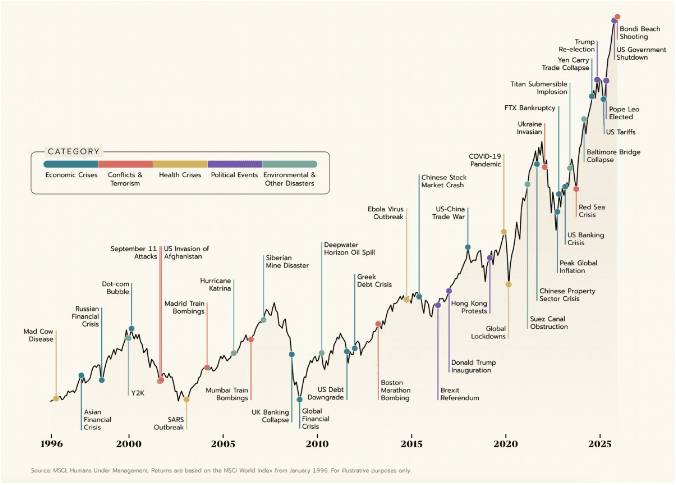
There is always something causing uncertainty, geopolitical tensions, economic concerns, interest rate changes or political developments. Yet over time, markets have consistently adapted, economies have continued to grow and businesses have kept innovating.
That doesn’t mean the journey is smooth. In fact, volatility is a normal part of investing. But history shows that markets continually adjust and advance over the long term.
For now, the most important thing is that people remain safe and that the situation de-escalates as quickly as possible. From an investment perspective, staying diversified, disciplined and focused on long-term goals remains the most sensible course through periods like this.
Enjoyed this article?
Get the next one delivered to your inbox.
Comments
Loading comments...
Related Articles
Continue reading more insights on financial planning.

Active vs. Passive: What This Year's Scorecard Really Says

Investment Risk: The Risk Of Low Returns And Falling Short Of Your Financial Goals