Should You Be Worried About Your Investments Right Now?

When markets fall sharply, it never feels routine; it feels different, more serious, more permanent.
And with everything going on in the world, that feeling can become even stronger. For many expats in the Middle East, there is already enough to think about without also seeing investments fall in value.
From an investment perspective though, it is important to remember that market falls are not unusual. They are part of investing. A correction is generally a fall of more than 10%, while a bear market is a fall of 20% or more. Since 1974, Schwab says there have been 27 market corrections, but only 6 turned into bear markets.
That is a useful reminder in itself. Not every sharp fall becomes something much worse.
Markets recover because businesses adapt
One of the most important things investors can remember is that markets are made up of real companies and companies do not just sit still when the world changes.
They adapt. They cut costs. They innovate. They respond to new consumer behaviour, new economic realities and new challenges. Over time, strong businesses evolve with the times, and their market value tends to reflect that.
That is a big reason why markets have historically gone on to recover after recessions, wars, financial crises, pandemics and political shocks. The headlines change, the environment changes, but businesses keep moving forward.
How long does recovery usually take?
There is no fixed timetable. Every downturn is different.
But history gives us perspective. Schwab says the average bear market since 1966 has lasted around 14 to 15 months, with an average decline of roughly 38%. By comparison, the average bull market has lasted close to 6 years.
Fidelity also notes that over the past 150 years, US stocks have fallen into bear-market territory roughly once every 6 years on average, with a median decline of 33%.
So yes, declines happen. But historically, the periods of growth have lasted much longer than the periods of decline.
The rebound is often stronger than people expect
This is the part many investors underestimate.
Fidelity research shows that after major market sell-offs, the median return one year after the market low was around 30% after corrections and around 37% after bear markets.
That does not guarantee future returns, of course.
But it does show why panic-selling can be so damaging. By the time the news starts sounding better, a large part of the recovery may already have happened.
Fidelity’s historical data on past bear markets also shows some very strong first-year rebounds. After the October 2002 low, the S&P 500 was up 33.7% in the following year. After the March 2009 low, it rose 68.6% in the next year.
The media rarely helps investors stay calm
This is also where perspective matters.
The media and world news will report negatively most of the time because negative stories attract attention. The more dramatic the headline, the more people click. That does not mean serious events are not serious. Some absolutely are.
But from an investment perspective, world events are often far more sensationalised in the news than they are financially permanent in markets.
Headlines are designed to capture what is going wrong today. Markets are trying to price what the world may look like tomorrow, that is a very important distinction.
Final thoughts
If you are feeling uneasy about markets right now, that is completely normal.
But history gives us a clear message: markets fall, businesses adapt, and recoveries do happen. Not instantly, and not neatly, but consistently enough that investors should be very careful about making long-term decisions based on short-term fear.
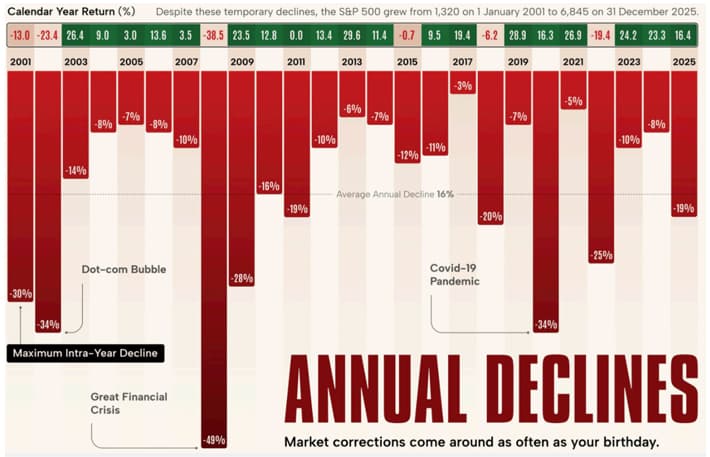
The short term can be noisy.
The headlines can be sensational.
But the strongest companies keep evolving, and over time their market prices tend to follow.
That is why staying calm matters, because in investing, it is often not the fall that does the damage; It is how investors react to it.
Ready to Take the Next Step?
That is why staying calm matters, because in investing, it is often not the fall that does the damage; It is how investors react to it.
Enjoyed this article?
Get the next one delivered to your inbox.
Comments
Loading comments...
Related Articles
Continue reading more insights on financial planning.

Active vs. Passive: What This Year's Scorecard Really Says

Investment Risk: The Risk Of Low Returns And Falling Short Of Your Financial Goals