Investment Risk: The Risk Of Low Returns And Falling Short Of Your Financial Goals

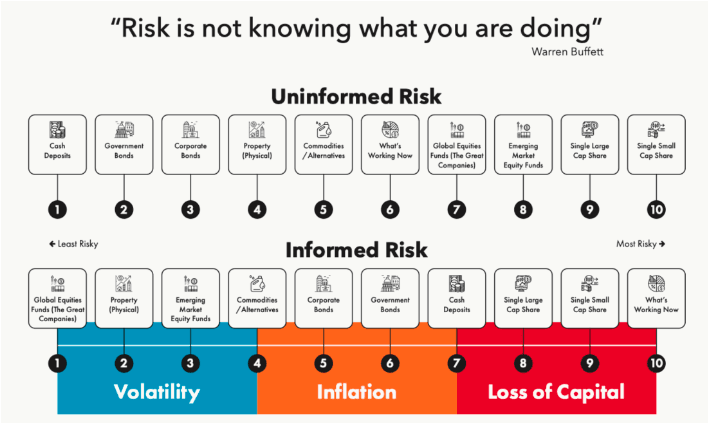
When you think about investment risk, what comes to mind? Most likely it’s markets falling, a crash, picking the wrong stock, investing at the worst possible time, missing out on the next big winner, that’s what most people mean when they talk about risk.
But in my experience, that isn’t the biggest risk at all. The biggest risk is misallocating your capital for decades, and oddly enough, it it often starts with a well-meaning risk questionnaire from an adviser.
You’ve probably experienced it if you have previous spoken with a financial adviser. You’re asked how you would feel if your portfolio fell 10% or 20%. Whether you would sell. Whether you prefer stability or growth. You answer honestly usually cautiously and you’re labelled “cautious”, “moderate” or “balanced”. From there, a portfolio is built that neatly fits that category. Now don’t get me wrong. Risk questionnaires serve a purpose. The advisory profession has come a long way in understanding investor behaviour, and that’s a positive thing.The problem is that most people are categorised before they’re educated.
If you’re new to investing, you probably haven’t yet seen how markets actually behave over long periods. You haven’t seen how often downturns occur, or how quickly and consistently they’ve recovered. You haven’t been shown the maths of compounding over 20 or 30 years. Instead, you’re asked how comfortable you are with volatility before you truly understand it.
That isn’t really advice; It’s administration, and if your financial adviser isn't asking your further questions and challenging results of a questionnaire, I'd argue that they aren't doing the job you've paid them to do.
A typical “balanced” portfolio might be 50% equities and 50% bonds. It feels sensible, responsible and mature. But if you have a 20–30 year investment term, which most retirement investors do, the greater risk may not be volatility at all; It may be the risk of low returns.
Let me make this tangible:
Imagine you start with £500,000 and invest for 25 years. You don’t add to it, you don’t withdraw from it when markets are turbulent, you simply let it grow. If that money is invested fully in global equities and achieves a growth rate of 9% per year, it grows to roughly £4.3 million over 25 years.
If instead you have a ''balanced'' portfolio split 50/50 between equities and bonds, assuming equities return 9% and bonds return 4%, the portfolio grows to around £2.4 million.
That’s a £1.9 million difference… Not because one investor picked better funds. Not because one timed the market perfectly. Simply because of allocation, compounding and possibly getting well qualified advice and education on how markets behave over time.
Now let me be absolutely clear. I am not saying you should put 100% of your money into equities. That would be lazy advice. As I've previously said, asset allocation must reflect your time horizon, your income needs, your liquidity requirements and importantly your temperament. If you need your capital in three to five years, high equity exposure may be completely inappropriate.
This also isn’t me saying equities are “good” and bonds are “bad”; It’s about making sure your allocation is driven by your objectives and time horizon, not simply by discomfort with short-term market movements. When you zoom out and look at history, global equity markets have endured world wars, depressions, oil crises, financial collapses and pandemics. They have fallen sharply at times, sometimes painfully so, but the Global Stockmarket is made up of real companies that sell real things to real people and over time, they adapt and evolve and always recover and progress higher.
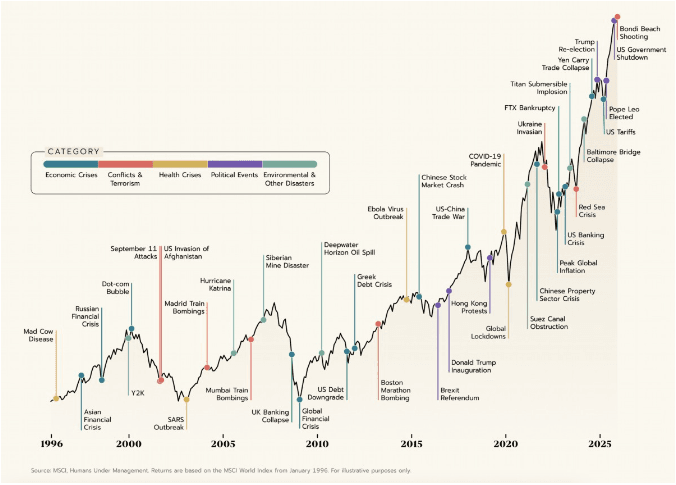
What tends to create permanent damage isn’t the market itself; It’s behaviour. Selling during downturns. Abandoning strategy halfway through the cycle. The best portfolio will always be the one you can stick to.
So what is investment risk, really?
It’s failing to achieve your lifetime objectives because your capital was structured incorrectly or because you reacted emotionally and did the wrong thing at the wrong time.
Context matters, education matters, behaviour matters more than most people realise. You don’t seek advice to be labelled “moderate”. You seek clarity. You want to understand how markets work, what normal volatility looks like and how your money needs to behave to support your life.
A thorough advisory process should explain the evidence, model the numbers and prepare you psychologically for downturns before they happen.
Because in investing, the biggest risk usually isn’t the market: It’s us.
Ready to Take the Next Step?
Enjoyed this article?
Get the next one delivered to your inbox.
Comments
Loading comments...
Related Articles
Continue reading more insights on financial planning.

Active vs. Passive: What This Year's Scorecard Really Says

8 Warning Signs You're Talking to the Wrong Financial Adviser